


Part 3/3: Conversations on design leadership
This article is the third article in our series in which I sit down with Anukriti Verma, a design manager. You can also find the series in her publication, Making design make sense, where she shares her reflections on career growth.
Today, we’re digging into something that’s top of mind for many of us, especially in the wake of all the industry shifts and AI buzz — what does the future of design leadership look like?
The Changing Face of Design Leadership
Harrison: Leadership isn’t static. It’s seasonal. Think about pre-COVID: leadership looked different, there was a focus on providing stability to teams and bringing about new ways of working in a full-remote workforce. Now, it’s about RTO (return to office), culture-building, and adapting to AI shifts. The job keeps evolving!
Anukriti: Absolutely! I’ve learned that as a leader, I’m an extension of the business—but that doesn’t mean I set aside my own perspective. The key is clarity. My team needs to understand what’s changing, why it’s happening, and how we move forward.
Harrison: That’s the essence of leadership-staying grounded, sharing openly, and letting your team know you’ve got their back. The more we communicate and adapt, the stronger we all become.
Anukriti: Yes, another thing that’s lately been on my mind is the shift in the design industry—it’s so much faster than I ever expected!
Layoffs in big tech. Shifting business models. Budgets tightening. AI reshaping workflows.
It’s no surprise that designers, managers, and leaders are asking, “Well, What’s next?”
There’s this underlying tension-almost like an identity crisis. And I don’t think this is just a phase we’re in—it is the new reality, and it’s one we need to navigate.
Harrison: It’s true. We came up in a time when things like the “Design Maturity Model” were considered gospel. You could measure a company’s design health by how many designers they had per engineer or how much influence design had on strategy. That made sense back then.
But look around, companies that were considered “design mature” are laying off entire teams. Others are racing to reposition themselves in AI, pivoting products overnight. The frameworks we used to swear by? They don’t fit anymore.
Anukriti: Totally, a lot of those ideal company standards are shifting. And if you’re feeling like you’re not designing the way you “should” be-maybe because your org isn’t the shining example from the books-that’s okay. What this all comes down to is that we need to rethink how we lead.
The Evolution of Design Skills
Anukriti: The phrase “full-stack” has been around forever in engineering. But now I’m hearing that design is also evolving in that direction too. What does it really even mean?
Recently, Tomer Cohen, LinkedIn’s Chief Product Officer, introduced the idea of “full-stack product builders”. The concept is pretty simple:
Anyone with a great idea can bring it to life.
Teams can form on the fly to tackle emerging priorities.
Skills matter more than titles.
How does this translate? For designers, this means expanding beyond craft.
You’d still own your design skill set including research and problem-solving.
But you also start incorporating product strategy, business metrics, and prototyping even beyond design tools.
You’d learn to balance ROI with user-centered design—Are users finding value in your product? How’s the product’s adoption? Are you impacting key business goals?
Harrison: Think of it as a new job description. It’s not just about wireframes and high-fidelity mocks anymore. It’s about being an equal partner in shaping the product, alongside PMs, engineers, and business leaders.
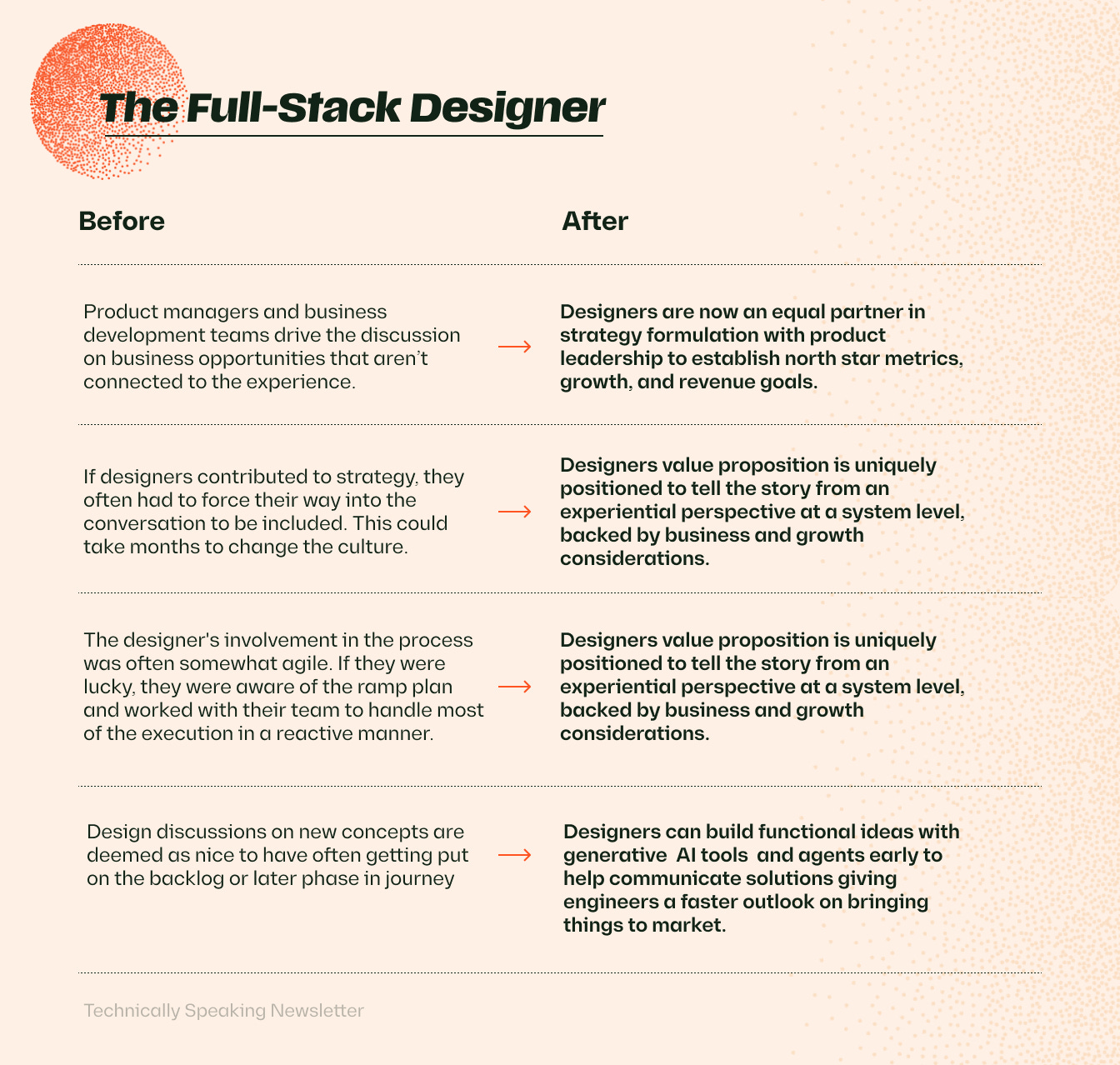
Here’s how the role of design has evolved:
Will PMs Take Over Design?
Harrison: Do you think product managers will take over design?
Anukriti: I don’t think so! PMs play an important role in product building but they have their own role. You could say that the lines between product and design are blurring. Designers who understand product strategy and business impact will survive this shift well.
Harrison: And what about PRDs? Are designers going to start writing them?
Anukriti: Maybe not traditional PRDs, but designers are already documenting strategy and user journeys at a higher level. My team has been creating “design briefs” for a while now. You could also call it a “design-driven product brief” if you want. The goal is the same—bridging business strategy with user experience.
Harrison: And what about managers? Where do they fit in all this?
Anukriti: I think that managers who rely solely on people management might struggle. The future is a player-coach model leader who can both guide teams and roll up their sleeves to navigate some hands-on design.
Anukriti: So, final question-do you think AI will replace design managers?
Harrison: Short answer: No. But AI will change the role of design leadership. The best leaders won’t just manage people; they’ll be hands-on, guiding teams through AI integration, product decisions, and culture shifts.
Some ways AI is already helping design leaders:
Onboarding: AI-driven companions that help new hires ramp up faster.
Talent Sourcing: AI-assisted recruiting to identify top candidates.
Process Automation: Less time on routine tasks, more time for strategy.
Anukriti: But at the end of the day, no AI can replace human judgment, empathy, or innovation, right? That’s still on us.
Harrison Facts!
Final Thoughts
Design maturity ebbs and flows. Today’s stable environment might become tomorrow’s reorg. If there’s anything we’ve learned, it’s that we can’t rely on static definitions of design leadership. Instead, we should focus on:
Being catalysts for cultural and strategic shifts
Having conviction in our design vision and the impact it can create
Telling the full narrative—connecting user value, business outcomes, and the evolving technology landscape (including AI)
That’s it for this issue. Thanks for reading, and I hope you’re walking away with a fresh perspective on where design leadership is headed. Let’s continue to adapt, learn, and shape the future of our craft together.
Stay curious and keep building.
You can now read up on our full three-part series: